
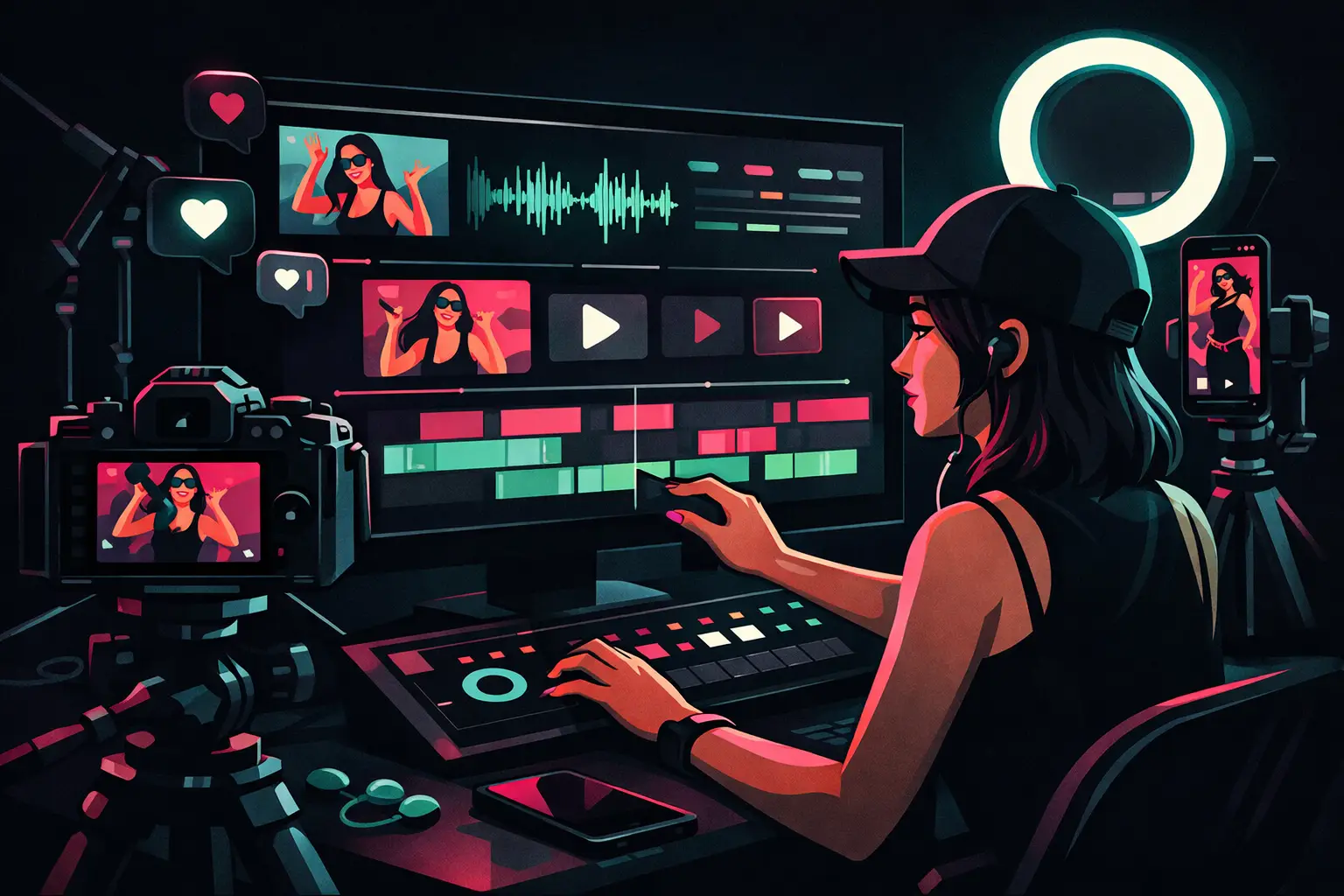
Video Editing for Social That Actually Performs
Book a Discovery Call
Most brands do not have a content problem. They have an editing problem.
They film enough. They post often enough. They even have decent ideas. But video editing for social is where momentum gets lost. The pacing drags. The hook lands late. The captions feel like an afterthought. Good footage goes live as average content.
That matters because social does not reward effort. It rewards retention. If the first seconds do not work, the rest of the edit does not matter.
What video editing for social really means
This is not traditional video production cut down for Instagram or TikTok. Different job. Different rules.
Video editing for social means shaping content for distracted viewers, muted playback, small screens and ruthless algorithms. It is less about making a video look expensive and more about making it impossible to ignore. That shift catches a lot of brands out.
A polished brand film can still flop on social. Why? Because social content lives or dies on speed, structure and clarity. The edit needs to get to the point fast, build curiosity fast and deliver value fast. Pretty transitions will not save weak timing.
The best social edits feel simple. That is usually a sign that they were thought through properly.
The first three seconds do most of the work
Scroll behaviour is brutal. People decide quickly. Stay or skip.
So the opening of a social video has one job. Earn the next second. Not explain everything. Not introduce the company with a logo animation. Not warm up slowly. Just make the viewer care enough to keep watching.
That can come from a strong spoken line, a sharp visual change, a bold claim, a problem the audience recognises, or a piece of movement that creates instant tension. Different formats need different hooks. A founder talking to camera needs one kind of opening. A product demo needs another. A UGC-style ad needs another again.
This is where many edits fail. They treat every clip like it deserves equal time. It does not. Social editing is selective. Ruthless, when needed.
Pace beats polish
There is a reason rougher edits often outperform highly produced ones. Social users are not sitting back to admire cinematography. They are scanning. Comparing. Deciding.
That does not mean quality does not matter. It does. Bad audio, poor framing and messy graphics still hurt performance. But pace usually matters more than polish. If an edit moves well, viewers forgive a lot. If it drags, they leave.
Pace is not the same as speed. Fast cuts everywhere can feel chaotic. Slow edits can still work if the tension holds. Good pacing is about rhythm. It gives the viewer a reason to stay, then another, then another.
That might mean trimming dead space between sentences. Cutting a line earlier than feels natural. Layering in captions that add emphasis instead of simply transcribing. Swapping to B-roll before attention drops. Holding on a close-up for impact, then moving on before it gets stale.
Done well, none of this feels mechanical. It just feels watchable.
Sound-off matters more than most brands think
A huge amount of social viewing happens with the sound off. Yet plenty of brands still edit as if everyone is listening through headphones.
That is a miss.
Captions are not just an accessibility feature. They are a retention tool. They help viewers follow the message instantly. They add energy. They can control emphasis. But they need to be designed properly. Tiny white subtitles dumped at the bottom of the frame are not enough.
Text placement, timing and hierarchy all matter. The right words should hit at the right moment. Key phrases need weight. Important lines need breathing room. And the edit cannot rely on captions to rescue weak footage or vague scripting. They work best when the underlying message is already clear.
Visual storytelling matters too. If someone watches without sound, can they still understand the point? In strong social editing, the answer is usually yes.
Every platform wants a different cut
One source file. Five channels. Same edit everywhere. That is how brands waste content.
Each platform has its own viewing habits, creative norms and pressure points. TikTok tends to reward immediacy and personality. Instagram often needs a cleaner balance between brand and spontaneity. Facebook still responds to direct clarity. YouTube Shorts needs sharp structure. LinkedIn video can work, but only when it respects the audience and drops the corporate tone.
That does not mean reinventing every asset from scratch. It means editing with context.
Aspect ratio is the obvious part. The less obvious part is intent. A paid social ad needs a tighter path to action than an organic behind-the-scenes clip. A spokesperson video needs confidence and clean framing. UGC-style creative often needs to feel quicker, looser and more native to the feed.
Same message. Different treatment.
Why over-editing can kill performance
Some brands ask for more motion, more effects, more layers, more everything. It sounds productive. It usually is not.
Too much editing can make a video feel forced. Overdesigned graphics, endless zooms, heavy transitions and constant visual noise pull attention away from the message. The result looks busy but lands flat.
Social content needs energy, not clutter.
The strongest edits know where to stay restrained. They use movement to support the idea, not distract from it. They know when a clean jump cut works better than a fancy transition. They know when the face on screen is the asset, not the thing to keep covering up.
This is especially true for performance creative. If the goal is clicks, leads or purchases, clarity wins. Every extra element needs a reason to exist.
Editing starts before post-production
A lot of editing issues are really planning issues.
If the footage lacks a strong opening, no editor can invent one from thin air. If the script rambles, the cut will struggle. If the speaker sounds unsure, trimming around it only goes so far. Strong social editing depends on strong raw material.
That is why the best results usually come from thinking about the edit before filming starts. What is the hook? What are the pattern interrupts? Which lines matter enough to become on-screen text? Where will the B-roll do the heavy lifting? What is the single action you want the viewer to take?
When that thinking happens early, the edit gets sharper. Faster too.
At Cruz Creative, that is often the gap clients want solved. Not just someone to cut clips together, but a team that understands how content needs to be built for social from the start.
What strong social edits usually have in common
Not a formula. A few shared traits.
They are clear. You know what the video is about almost instantly. They are purposeful. Every scene earns its place. They respect attention. No long intros. No bloated setups. They also feel native to the platform instead of recycled from somewhere else.
Most importantly, they create movement towards something. A reaction. A click. A save. A message. Social content should do a job.
That job changes by brand and objective. A luxury product launch needs a different edit from a direct-response ad. A founder brand may benefit from more face-led content. A service business may need clearer proof and stronger framing. There is no single best style. There is only the right edit for the outcome.
The trade-off brands need to accept
You can optimise for brand feel. You can optimise for platform performance. The best work finds the overlap, but there is always a tension between the two.
Some brands lean so hard into polish that the content stops feeling native. Others chase trends so aggressively that they lose credibility. Neither extreme helps.
Good video editing for social sits in the middle. Strong enough to reflect the brand. Sharp enough to perform in the feed. That balance takes judgement, not just software skills.
And yes, it depends on who you are talking to. A premium brand may need more restraint. A challenger brand may need more bite. A camera-shy founder may need tighter edits that build confidence without feeling unnatural. Context changes the cut.
What to look for if you outsource editing
Do not just ask to see a flashy showreel. Ask whether the editor or agency understands retention, platform behaviour and conversion. Ask how they approach hooks. Ask how they cut for paid versus organic. Ask how quickly they can turn content around without dropping quality.
Execution matters. Reliability matters too.
The right partner should make your content sharper, faster and easier to ship. Not bury you in process. Not disappear for a week. Not send back edits that look nice but ignore performance.
That is the standard now. Social moves too fast for anything else.
Strong editing will not fix a weak offer. It will not replace strategy. But it will decide whether good ideas get noticed or ignored.
If your content is underperforming, start there. Not with more posting. Not with another trend. With the cut.
Because on social, the difference between scroll-past and stop-and-watch is rarely luck. It is usually editing.
Book a Discovery Call
Most brands do not have a content problem. They have an editing problem.
They film enough. They post often enough. They even have decent ideas. But video editing for social is where momentum gets lost. The pacing drags. The hook lands late. The captions feel like an afterthought. Good footage goes live as average content.
That matters because social does not reward effort. It rewards retention. If the first seconds do not work, the rest of the edit does not matter.
What video editing for social really means
This is not traditional video production cut down for Instagram or TikTok. Different job. Different rules.
Video editing for social means shaping content for distracted viewers, muted playback, small screens and ruthless algorithms. It is less about making a video look expensive and more about making it impossible to ignore. That shift catches a lot of brands out.
A polished brand film can still flop on social. Why? Because social content lives or dies on speed, structure and clarity. The edit needs to get to the point fast, build curiosity fast and deliver value fast. Pretty transitions will not save weak timing.
The best social edits feel simple. That is usually a sign that they were thought through properly.
The first three seconds do most of the work
Scroll behaviour is brutal. People decide quickly. Stay or skip.
So the opening of a social video has one job. Earn the next second. Not explain everything. Not introduce the company with a logo animation. Not warm up slowly. Just make the viewer care enough to keep watching.
That can come from a strong spoken line, a sharp visual change, a bold claim, a problem the audience recognises, or a piece of movement that creates instant tension. Different formats need different hooks. A founder talking to camera needs one kind of opening. A product demo needs another. A UGC-style ad needs another again.
This is where many edits fail. They treat every clip like it deserves equal time. It does not. Social editing is selective. Ruthless, when needed.
Pace beats polish
There is a reason rougher edits often outperform highly produced ones. Social users are not sitting back to admire cinematography. They are scanning. Comparing. Deciding.
That does not mean quality does not matter. It does. Bad audio, poor framing and messy graphics still hurt performance. But pace usually matters more than polish. If an edit moves well, viewers forgive a lot. If it drags, they leave.
Pace is not the same as speed. Fast cuts everywhere can feel chaotic. Slow edits can still work if the tension holds. Good pacing is about rhythm. It gives the viewer a reason to stay, then another, then another.
That might mean trimming dead space between sentences. Cutting a line earlier than feels natural. Layering in captions that add emphasis instead of simply transcribing. Swapping to B-roll before attention drops. Holding on a close-up for impact, then moving on before it gets stale.
Done well, none of this feels mechanical. It just feels watchable.
Sound-off matters more than most brands think
A huge amount of social viewing happens with the sound off. Yet plenty of brands still edit as if everyone is listening through headphones.
That is a miss.
Captions are not just an accessibility feature. They are a retention tool. They help viewers follow the message instantly. They add energy. They can control emphasis. But they need to be designed properly. Tiny white subtitles dumped at the bottom of the frame are not enough.
Text placement, timing and hierarchy all matter. The right words should hit at the right moment. Key phrases need weight. Important lines need breathing room. And the edit cannot rely on captions to rescue weak footage or vague scripting. They work best when the underlying message is already clear.
Visual storytelling matters too. If someone watches without sound, can they still understand the point? In strong social editing, the answer is usually yes.
Every platform wants a different cut
One source file. Five channels. Same edit everywhere. That is how brands waste content.
Each platform has its own viewing habits, creative norms and pressure points. TikTok tends to reward immediacy and personality. Instagram often needs a cleaner balance between brand and spontaneity. Facebook still responds to direct clarity. YouTube Shorts needs sharp structure. LinkedIn video can work, but only when it respects the audience and drops the corporate tone.
That does not mean reinventing every asset from scratch. It means editing with context.
Aspect ratio is the obvious part. The less obvious part is intent. A paid social ad needs a tighter path to action than an organic behind-the-scenes clip. A spokesperson video needs confidence and clean framing. UGC-style creative often needs to feel quicker, looser and more native to the feed.
Same message. Different treatment.
Why over-editing can kill performance
Some brands ask for more motion, more effects, more layers, more everything. It sounds productive. It usually is not.
Too much editing can make a video feel forced. Overdesigned graphics, endless zooms, heavy transitions and constant visual noise pull attention away from the message. The result looks busy but lands flat.
Social content needs energy, not clutter.
The strongest edits know where to stay restrained. They use movement to support the idea, not distract from it. They know when a clean jump cut works better than a fancy transition. They know when the face on screen is the asset, not the thing to keep covering up.
This is especially true for performance creative. If the goal is clicks, leads or purchases, clarity wins. Every extra element needs a reason to exist.
Editing starts before post-production
A lot of editing issues are really planning issues.
If the footage lacks a strong opening, no editor can invent one from thin air. If the script rambles, the cut will struggle. If the speaker sounds unsure, trimming around it only goes so far. Strong social editing depends on strong raw material.
That is why the best results usually come from thinking about the edit before filming starts. What is the hook? What are the pattern interrupts? Which lines matter enough to become on-screen text? Where will the B-roll do the heavy lifting? What is the single action you want the viewer to take?
When that thinking happens early, the edit gets sharper. Faster too.
At Cruz Creative, that is often the gap clients want solved. Not just someone to cut clips together, but a team that understands how content needs to be built for social from the start.
What strong social edits usually have in common
Not a formula. A few shared traits.
They are clear. You know what the video is about almost instantly. They are purposeful. Every scene earns its place. They respect attention. No long intros. No bloated setups. They also feel native to the platform instead of recycled from somewhere else.
Most importantly, they create movement towards something. A reaction. A click. A save. A message. Social content should do a job.
That job changes by brand and objective. A luxury product launch needs a different edit from a direct-response ad. A founder brand may benefit from more face-led content. A service business may need clearer proof and stronger framing. There is no single best style. There is only the right edit for the outcome.
The trade-off brands need to accept
You can optimise for brand feel. You can optimise for platform performance. The best work finds the overlap, but there is always a tension between the two.
Some brands lean so hard into polish that the content stops feeling native. Others chase trends so aggressively that they lose credibility. Neither extreme helps.
Good video editing for social sits in the middle. Strong enough to reflect the brand. Sharp enough to perform in the feed. That balance takes judgement, not just software skills.
And yes, it depends on who you are talking to. A premium brand may need more restraint. A challenger brand may need more bite. A camera-shy founder may need tighter edits that build confidence without feeling unnatural. Context changes the cut.
What to look for if you outsource editing
Do not just ask to see a flashy showreel. Ask whether the editor or agency understands retention, platform behaviour and conversion. Ask how they approach hooks. Ask how they cut for paid versus organic. Ask how quickly they can turn content around without dropping quality.
Execution matters. Reliability matters too.
The right partner should make your content sharper, faster and easier to ship. Not bury you in process. Not disappear for a week. Not send back edits that look nice but ignore performance.
That is the standard now. Social moves too fast for anything else.
Strong editing will not fix a weak offer. It will not replace strategy. But it will decide whether good ideas get noticed or ignored.
If your content is underperforming, start there. Not with more posting. Not with another trend. With the cut.
Because on social, the difference between scroll-past and stop-and-watch is rarely luck. It is usually editing.
Book a Discovery Call
Most brands do not have a content problem. They have an editing problem.
They film enough. They post often enough. They even have decent ideas. But video editing for social is where momentum gets lost. The pacing drags. The hook lands late. The captions feel like an afterthought. Good footage goes live as average content.
That matters because social does not reward effort. It rewards retention. If the first seconds do not work, the rest of the edit does not matter.
What video editing for social really means
This is not traditional video production cut down for Instagram or TikTok. Different job. Different rules.
Video editing for social means shaping content for distracted viewers, muted playback, small screens and ruthless algorithms. It is less about making a video look expensive and more about making it impossible to ignore. That shift catches a lot of brands out.
A polished brand film can still flop on social. Why? Because social content lives or dies on speed, structure and clarity. The edit needs to get to the point fast, build curiosity fast and deliver value fast. Pretty transitions will not save weak timing.
The best social edits feel simple. That is usually a sign that they were thought through properly.
The first three seconds do most of the work
Scroll behaviour is brutal. People decide quickly. Stay or skip.
So the opening of a social video has one job. Earn the next second. Not explain everything. Not introduce the company with a logo animation. Not warm up slowly. Just make the viewer care enough to keep watching.
That can come from a strong spoken line, a sharp visual change, a bold claim, a problem the audience recognises, or a piece of movement that creates instant tension. Different formats need different hooks. A founder talking to camera needs one kind of opening. A product demo needs another. A UGC-style ad needs another again.
This is where many edits fail. They treat every clip like it deserves equal time. It does not. Social editing is selective. Ruthless, when needed.
Pace beats polish
There is a reason rougher edits often outperform highly produced ones. Social users are not sitting back to admire cinematography. They are scanning. Comparing. Deciding.
That does not mean quality does not matter. It does. Bad audio, poor framing and messy graphics still hurt performance. But pace usually matters more than polish. If an edit moves well, viewers forgive a lot. If it drags, they leave.
Pace is not the same as speed. Fast cuts everywhere can feel chaotic. Slow edits can still work if the tension holds. Good pacing is about rhythm. It gives the viewer a reason to stay, then another, then another.
That might mean trimming dead space between sentences. Cutting a line earlier than feels natural. Layering in captions that add emphasis instead of simply transcribing. Swapping to B-roll before attention drops. Holding on a close-up for impact, then moving on before it gets stale.
Done well, none of this feels mechanical. It just feels watchable.
Sound-off matters more than most brands think
A huge amount of social viewing happens with the sound off. Yet plenty of brands still edit as if everyone is listening through headphones.
That is a miss.
Captions are not just an accessibility feature. They are a retention tool. They help viewers follow the message instantly. They add energy. They can control emphasis. But they need to be designed properly. Tiny white subtitles dumped at the bottom of the frame are not enough.
Text placement, timing and hierarchy all matter. The right words should hit at the right moment. Key phrases need weight. Important lines need breathing room. And the edit cannot rely on captions to rescue weak footage or vague scripting. They work best when the underlying message is already clear.
Visual storytelling matters too. If someone watches without sound, can they still understand the point? In strong social editing, the answer is usually yes.
Every platform wants a different cut
One source file. Five channels. Same edit everywhere. That is how brands waste content.
Each platform has its own viewing habits, creative norms and pressure points. TikTok tends to reward immediacy and personality. Instagram often needs a cleaner balance between brand and spontaneity. Facebook still responds to direct clarity. YouTube Shorts needs sharp structure. LinkedIn video can work, but only when it respects the audience and drops the corporate tone.
That does not mean reinventing every asset from scratch. It means editing with context.
Aspect ratio is the obvious part. The less obvious part is intent. A paid social ad needs a tighter path to action than an organic behind-the-scenes clip. A spokesperson video needs confidence and clean framing. UGC-style creative often needs to feel quicker, looser and more native to the feed.
Same message. Different treatment.
Why over-editing can kill performance
Some brands ask for more motion, more effects, more layers, more everything. It sounds productive. It usually is not.
Too much editing can make a video feel forced. Overdesigned graphics, endless zooms, heavy transitions and constant visual noise pull attention away from the message. The result looks busy but lands flat.
Social content needs energy, not clutter.
The strongest edits know where to stay restrained. They use movement to support the idea, not distract from it. They know when a clean jump cut works better than a fancy transition. They know when the face on screen is the asset, not the thing to keep covering up.
This is especially true for performance creative. If the goal is clicks, leads or purchases, clarity wins. Every extra element needs a reason to exist.
Editing starts before post-production
A lot of editing issues are really planning issues.
If the footage lacks a strong opening, no editor can invent one from thin air. If the script rambles, the cut will struggle. If the speaker sounds unsure, trimming around it only goes so far. Strong social editing depends on strong raw material.
That is why the best results usually come from thinking about the edit before filming starts. What is the hook? What are the pattern interrupts? Which lines matter enough to become on-screen text? Where will the B-roll do the heavy lifting? What is the single action you want the viewer to take?
When that thinking happens early, the edit gets sharper. Faster too.
At Cruz Creative, that is often the gap clients want solved. Not just someone to cut clips together, but a team that understands how content needs to be built for social from the start.
What strong social edits usually have in common
Not a formula. A few shared traits.
They are clear. You know what the video is about almost instantly. They are purposeful. Every scene earns its place. They respect attention. No long intros. No bloated setups. They also feel native to the platform instead of recycled from somewhere else.
Most importantly, they create movement towards something. A reaction. A click. A save. A message. Social content should do a job.
That job changes by brand and objective. A luxury product launch needs a different edit from a direct-response ad. A founder brand may benefit from more face-led content. A service business may need clearer proof and stronger framing. There is no single best style. There is only the right edit for the outcome.
The trade-off brands need to accept
You can optimise for brand feel. You can optimise for platform performance. The best work finds the overlap, but there is always a tension between the two.
Some brands lean so hard into polish that the content stops feeling native. Others chase trends so aggressively that they lose credibility. Neither extreme helps.
Good video editing for social sits in the middle. Strong enough to reflect the brand. Sharp enough to perform in the feed. That balance takes judgement, not just software skills.
And yes, it depends on who you are talking to. A premium brand may need more restraint. A challenger brand may need more bite. A camera-shy founder may need tighter edits that build confidence without feeling unnatural. Context changes the cut.
What to look for if you outsource editing
Do not just ask to see a flashy showreel. Ask whether the editor or agency understands retention, platform behaviour and conversion. Ask how they approach hooks. Ask how they cut for paid versus organic. Ask how quickly they can turn content around without dropping quality.
Execution matters. Reliability matters too.
The right partner should make your content sharper, faster and easier to ship. Not bury you in process. Not disappear for a week. Not send back edits that look nice but ignore performance.
That is the standard now. Social moves too fast for anything else.
Strong editing will not fix a weak offer. It will not replace strategy. But it will decide whether good ideas get noticed or ignored.
If your content is underperforming, start there. Not with more posting. Not with another trend. With the cut.
Because on social, the difference between scroll-past and stop-and-watch is rarely luck. It is usually editing.